|
I have the honor of appearing on a few
court-appointed lists in the area. This means I represent clients for
misdemeanor, felony, and child protective/ delinquency cases.
One of the perks of my job is that I get to read a lot of
police reports, and talk to police officers and detectives a lot. The reason
why I say this is a “perk” is that it makes me look at the arguments law
enforcement would use if the case goes to trial, and how police psychology
works. It’s actually quite underhanded and manipulative once you break it down
into its pieces.
Sometimes potential clients call me with the following scenario: “I was at a party last weekend, with a lot of friends. My friends tell me that Tom says that I committed a crime against him, and that he called the cops. Should I talk to the cops?” My advice is always “No, you have no obligation to talk to the cops.” And then I tell the potential client “if the cops call you, tell them you won’t be questioned without a lawyer present.”
1.
The
format: Police reports are written in a good guy/ bad guy format. It’s like
a play. Usually –and I can’t think of a time I have seen it any other way -- the person who calls the cops is the “good”
guy. Once the cops identify the rest of the players in the play, they will try
to finger one person (or possibly a
group of people, who end up as co-defendants) as the “bad guy.”
This is the beginning of how the mind set of law enforcement works. It’s easier to sell the story to a jury if the play is simple. Good guy / bad guy is a scenario we have all seen, and the jury will want vengeance, justice, or something, for the good guy. This is how a conviction is made. Also, police and prosecutors know their audiences: it is the general public. What is the general public’s IQ? How does the general public feel about victims and justice?
2.
Corroboration:
Talking to the victim, or alleged
victim as I like to call him/her, gives the cops a list of other people to talk
to, witnesses, before they talk to the person they’re trying to cast in the
“bad guy” role.
This is how under-handed the police mindset is, as talking to other witnesses first becomes a set-up for the defendant to put his own picture in the frame, or cast himself in the starring role. It also gives police an inside edge, as this leads to a cross-examining of the defendant from their first contact. This part of the officer’s job. And it works in their favor as talking to other witnesses gives “corroboration” to the alleged victim’s story. If the witnesses back up the victim’s story, then the cops have some corroboration, and the victim’s story sounds more like it would stand up in court. Back to selling this story to a jury: if there’s a witness who says the same thing as the alleged victim, then the jury will have more sympathy toward the alleged victim, and it is easier to get a conviction.
3.
Contacting
the defendant: The scene is now set, the cops have a victim, and some
witnesses. Now all they need in the play is the bad guy.
Once the cops call the potential defendant, they begin with what is called a “leading” question. Sometimes these are called open-ended questions. It’s the sort of question an interviewer uses on a job interview, such as “where do you see yourself in five years?” it doesn’t lead to a “yes” or “no,” instead it leads to more of an explanatory answer. Or, in the potential scenario of being pulled over, it sounds more like this “How fast did you think you were going?” This leads to an answer that can be incriminating such as “I’m not sure, but I think was going about 35.” Except in our “play,” as written by the police, it sounds a bit more like “Hi, Jim. My name is officer Bishop with the County sheriff’s office. Tom talked to us, and said you committed a crime against him.”
This open-ended statement might lead a
person to possibly deny the assertion, or to try to correct the cops. The
problem is that any other statement a potential defendant makes at this point
can be used to cast him in the role of bad guy, no matter the answer.
Usually by this time, again, cops have
talked to other witnesses, and so once the defendant says something, an officer
can counter with “Well, Mr. Johnson said you went after Tom with a carving
knife.” Here’s the corroboration coming to assist the cops, and further
explanations by defendants are only helping the police.
Also, the next thing a defendant says – even if it is the truth -- may lead to a credibility problem. The options are to either a) deny what has been said by Mr. Johnson, or possibly point the finger at someone else; or b) deny what was said totally. (Option (c) is also available, however).
At the first contact by police, asserting
an attorney’s assistance would be helpful. Instead, defendant should answer,
“I’m sorry officer, but I can’t talk to you without my attorney present.”
That’s option (c), which no one seems to take!
Either way, the cops have an alleged victim, and a corroborating witness who already say nearly the same thing. But according to the defendant, those two are both liars now. That won’t seem likely to a potential jury, will it? This is just grist for the mill of the prosecution. Think again of the audience, which is the general public. Who should the jury believe: the defendant – or all of the possible ways to agree with the prosecution: instead the jury can believe the alleged victim, officer testimony, credible witness testimony . . . Police also know that facts are confusing – the victim and one or two witnesses usually get a few facts wrong, but this still can be OK to a jury. The victim is sympathetic; so it makes sense what with being attacked that the victim might get a few facts wrong.
4.
The
defendant’s natural response woks against him. This is where manipulation
also comes into play, in case it wasn’t used already when contacting the
defendant. Most people are raised to think that the cops are good people, and
that working with the cops will help everyone (even when being questioned about
something).
A
second natural response happens when police contact a suspect. The suspect
wants to “set the record straight” about what really happened. This works
against the suspect as well. The police aren’t interested in getting it
straight, they are interested in the “good guy/ bad guy” scenario.
Back to my job: I can’t tell you how many times I have had clients tell me “I was respectful”-- “I didn’t make a scene,”-- or “I cooperated.” Even clients with fairly extensive criminal records tell me this, when their prior involvement with law enforcement should have them knowing better. Who cares whether you cooperate with the police? The police will do their job whether you cooperate or not. And that’s what they are paid to do, so why help them to do their job? I don’t see the cops coming along to help you do yours, now do I?
5.
The fact
that cops wear uniforms works in their favor. It’s intimidating, for one.
Second, it tends to lead to obedience on the part of defendants. Clients
/defendants know that cops have uniforms, guns, and jails at their disposal. So
it’s easier for cops to get compliance, and so defendants/ clients to give in
to authority: the alternative can be scary – even if you are innocent. Third,
it is de-humanizing. It’s not a guy who happens to be a cop, it’s a cop! People
see the uniform, but not the individual in uniform.

7.
|

Showing posts with label Constitutional Law. Show all posts
Showing posts with label Constitutional Law. Show all posts
Monday, November 12, 2018
Talk to the cops? Are you crazy?

Monday, May 15, 2017
What is pleading the fifth? That's for defendants, not witnesses, right?
Q: what is pleading the Fifth? Isn't that only for defendant? I don't have a subpoena yet, but I think I will have to testify. The problem is, I said things to the police while I was angry. Now my fiancee is being charged, I don't want to testify against him, I love him.
A: Hi, thanks for your question.
The way I understand your question is: You gave an earlier statement to the police, your fiancee was charged as a result. Now, the court is trying to see whether the charges against your fiancee are proven beyond a reasonable doubt, and to do that you may be called to testify.
The problem you are facing is that if you are called to testify truthfully, and do not, will the prosecutor decide to charge you with perjury (which is the technical name for making a false statement)? Perhaps you should seek a one-to-one consultation with an attorney to see what else you need to defend against.
"Pleading the fifth" is not only available to defendants, but also to witnesses, who may be chargeable as defendants.
Again, I suggest you talk to an attorney (preferrably not the same attorney your fiancee has) for more advice.
Yours,
Nancy
Wednesday, July 6, 2016
Q & A: Real estate purchase and zoning laws: can the township authority make me do this?
Q: My mom has some acreage (not much, actually, less than ten acres). She wants to sell me a parcel of her property so that I can build on it. I live in a crummy area, there's a lot of drug dealers around me. I want to build on that land I'm buying from my mom, and bring my kids to that school district too, which is better for everyone. The land has always been in our family, and probably always will be. The problem is that it is zoned agricultural. I have also heard that the township won't let land be parceled smaller than 8 acres in that area. Can the township authority do that, stop me from building because it's zoning it that way? Can they stop my mom from selling to me based on the size of the parcel?
A: Probably, the township authority can do that.
Your questions center on the area of real estate law, specifically zoning, and the validity of zoning laws.
The thing is that governments (in this case, the township authority) is not supposed to interfere with property rights. Property rights loosely means you can use your property (the land your mom wants to sell you will become yours) however you want to use it. This right to use the property usually applies to how it is sold, legally this is referred to as making property "freely alienable," or easily sold, given away, etc. Governments are not supposed to do things that make it hard for you to use or sell your property.
However, since the area is zoned agriculturally, it may present a barrier. The problem is that the zoning law is usually upheld - this means that townships like yours can (usually) show that there's a community interest in keeping things the way they are - if it is zoned as agricultural, it may have to stay agricultural. That is, unless, you can show (through an appeal to the zoning board before the property is sold to you) that the continuance of zoning is unreasonable because there is no possible way for the property to continue as agricultural use. The best fact you have going for you in this scenario is that the parcel she has already is sort of small (for agricultural use), but does that mean that it wouldn't ever be useful as agricultural again? That's what a zoning board of appeals would have to decide.
Thursday, March 31, 2016
Pre-trial "freeze" of assets violates the 6th Amendment, says Supreme Court
Imagine if you will: a person who is suspected of a crime, and may have had some income from that crime, is being investigated as a suspect. Federal authorities were allowed to "freeze" that suspect's assets, including bank accounts, and other things. It was essentially a way to make sure the asset (if connected with the crime) would not be used by the defendant, in case there was restitution ordered (or so a prosecutor would argue).
A federal law that allows courts to order pretrial freezes on assets that are untainted by crime violates the Sixth Amendment rights of defendants who are unable to pay their lawyers, the U.S. Supreme Court has ruled in a 5-3 decision.Article here (via aba journal).
The court ruled (PDF) Wednesday on behalf of Sila Luis, who was charged with Medicare fraud. The government obtained a pretrial order freezing $2 million in assets in hopes of preserving the money for restitution and penalties. The order was obtained under a law that allows pretrial freezes on assets that are tied to a crime, as well as assets “of equivalent value.”
The “equivalent value” provision is unconstitutional to the extent it prevents the defendant from paying her lawyer, the Supreme Court found.
Wednesday, February 24, 2016
State Bar of Michigan hosting panel discusson on use of police body cameras
The State Bar of Michigan Law and the Media Committee will host a panel discussion on the use of police body cameras.
Up to 95% of police departments in US major cities plan to implement body cams in the near future. (Grand Rapids already has implemented it). This is according to a study by Major Cities Chiefs Association and Major County Sherrifs Association.
The thing is that wearing cameras impacts other areas of law, such as constitutional rights, and privacy.
Article here (via SBM blog).
The
State Bar of Michigan Law and the Media Committee will host a panel
discussion called “Body Cams: Competing Issues of Transparency, Privacy,
and Constitutional Rights” from 12:30 to 1:30 p.m. on March 9 at the
Spencer M. Patrich Auditorium at Wayne State University Law School in
Detroit. The Wolverine Bar Association will cosponsor the discussion.
A recent survey conducted by the Major Cities Chiefs Association and Major County Sheriffs' Association found that up to 95 percent of large police departments in the U.S. plan to implement a body camera program in the near future.
- See more at: http://sbmblog.typepad.com/sbm-blog/2016/02/sbm-law-the-media-committee-panel-hosts-discussion-on-police-use-of-body-cameras.html#sthash.LYfzaTTX.dpuf
Tuesday, February 23, 2016
Bob Dylan explained "standing" (or so says Chief Justice Roberts)
“Bob Dylan captured the whole notion behind standing,” Roberts said. “In
that case, the party didn’t have anything at stake in the case and had
nothing to lose, and the case should have been thrown out on that
basis.”
Article here (via ABA Journal).
Standing is the legal concept that in order to appear in a law suit, the parties have to have some skin in the game. If you're mad because a law was enacted, but the law doesn't effect you, then you have no standing, and can't sue to "test" the law.
Article here (via ABA Journal).
Standing is the legal concept that in order to appear in a law suit, the parties have to have some skin in the game. If you're mad because a law was enacted, but the law doesn't effect you, then you have no standing, and can't sue to "test" the law.
Monday, February 22, 2016
Finite terms for SCOTUS justices would solve problems, says editorial
The Washington Post’s editorial board sees a connection between life
tenure for Supreme Court justices and the “dysfunctional politics of
judicial nominations.”
In an editorial published on Sunday, the Washington Post says the Constitution relied on life tenure to strike a balance between democratic accountability and judicial independence. But that mechanism is failing, the editorial says.
Article here (via ABA Journal).
In an editorial published on Sunday, the Washington Post says the Constitution relied on life tenure to strike a balance between democratic accountability and judicial independence. But that mechanism is failing, the editorial says.
Article here (via ABA Journal).
Wednesday, February 10, 2016
Lawsuit claims "scarlet letter" passports for sex offenders are unconstitutional
A bill that President Obama signed into law
on Monday requires that passports used by registered sex offenders
carry a "conspicuous" mark to ensure the bearers are properly
scrutinized, shunned, harassed, and stigmatized wherever they might
travel.
A federal lawsuit filed yesterday in San Francisco argues that the so-called International Megan's Law (IML), which passed both houses of Congress on voice votes without any real debate, violates the First Amendment, the Fifth Amendment, and the Ex Post Facto Clause.
Article here.
A federal lawsuit filed yesterday in San Francisco argues that the so-called International Megan's Law (IML), which passed both houses of Congress on voice votes without any real debate, violates the First Amendment, the Fifth Amendment, and the Ex Post Facto Clause.
Article here.
Friday, February 5, 2016
Federal Appeals Court rules gun legislation must be held to "strict scrutiny" standard (instead of rational-basis)
For the first time, a federal appeals court has held that a state’s
ban on “assault” long guns and “high-capacity” magazines must be held to
the highest level of judicial scrutiny. In a 2–1 decision, the Circuit
Court of Appeals for the Fourth Circuit (which covers Maryland, North
Carolina, South Carolina, Virginia, and West Virginia) held that
Maryland’s Firearm Safety Act must be evaluated under the same stringent
standard that courts routinely use to strike down race-based
governmental discrimination and categorical bans on speech, since, like
them, the law seeks to restrict a core constitutional freedom.
Read more at this link
Read more at this link
(via National Review).
Just so you know: the difference between rational basis review and strict scrutiny is pretty big. Rational basis means that if a court hears a case that is trying to determine the constitutionality of a law, and the court itself can devise a reason why it might be constitutional, then the court can allow that law to then be constitutional * (this is my explanation of the more complete, wordier version that you can read here on Wiki).
Strict scrutiny, by contrast, is the highest (hence using the word strict, and scrutiny) level of review for cases that are about constitutional issues. When a case is touching on fundamental rights, that are part of the Bill of Rights or other parts of the Constitution, they will be presumed to have violated the Constitution unless it can be 1) justified by a compelling governmental interest, and 2) it is narrowly tailored, and 3) it is also the least restrictive means for achieving that interest. Laws often (not surprisingly) fail this test. (again, read the Wiki outline of SS here).
Strict scrutiny, by contrast, is the highest (hence using the word strict, and scrutiny) level of review for cases that are about constitutional issues. When a case is touching on fundamental rights, that are part of the Bill of Rights or other parts of the Constitution, they will be presumed to have violated the Constitution unless it can be 1) justified by a compelling governmental interest, and 2) it is narrowly tailored, and 3) it is also the least restrictive means for achieving that interest. Laws often (not surprisingly) fail this test. (again, read the Wiki outline of SS here).
** RB review: "if the court can merely hypothesize a "legitimate" interest served by
the challenged action, it will withstand rational basis review"
Monday, December 7, 2015
Why not ship some beer for Christmas? Well, because it's illegal (at least in Michigan, for the most part).
Cyber Monday has come and gone. But there is still time to buy! But one thing you can't do, for the most part, is have some beer (or alcohol of any kind) shipped to Michigan (for the most part).
Why? Because the Liquor Control Commission says so.
The thing is, the LCC wants to bring as much revenue as it can into the state. It controls that (hence the name). So every consumer who buys alcohol of any kind is violating the LCC's ability to control things.
Here's another article about this (it's old and lists Granholm as governor, but is still accurate.) Here's a link to the LCC page about importation of alcohol.
How do you get around it? It's not easy. This author tried to buy wines from nakedwines.com, but couldn't have the order ship to Michigan. Essentially an online retailer has to purchase a special license from the LCC to be able to ship their products to Michigan. If you happen to shop at an online retailer who doesn't have that license, there's no guarantee that your order will arrive.
Tuesday, October 27, 2015
Michigan law maker proposes new Sex Offender Registry changes after 1,000 ft radius declared unconstitutional
Portions of the Sex Offender Registry (SOR) law were declared unconstitutional earlier this year. That's because the requirement that people on the SOR were supposed to stay at least 1,000 feet from a school at all times.
Article here.
But never fear, Michigan law makers are ready to amend the 1994 legislation - yet again- to re-include the 1,000 ft requirement, and in such a way that the law would not be considered over-broad.
More details to follow. . . .
Article here.
But never fear, Michigan law makers are ready to amend the 1994 legislation - yet again- to re-include the 1,000 ft requirement, and in such a way that the law would not be considered over-broad.
More details to follow. . . .
Tuesday, September 8, 2015
Lack of minority representation in jury pool gets new trial for convicted murderer
A Hispanic man convicted of second-degree murder in 2001 deserves a
new trial because a computer glitch left minorities underrepresented in
his jury pool, a federal appeals panel said Friday, Sept. 4.
Antonio Garcia-Dorantes, 37, was convicted in the Oct. 22, 2000, stabbing death of Jose Delores Gomez and wounding of Manual Garcia.
Article here (via mlive).
Antonio Garcia-Dorantes, 37, was convicted in the Oct. 22, 2000, stabbing death of Jose Delores Gomez and wounding of Manual Garcia.
Article here (via mlive).
Thursday, August 6, 2015
Michigan Supreme Court says judges don't have to follow sentencing guidelines
Who should decide how a defendant is sentenced? A jury or a judge?
This was the question before the Michigan Supreme Court in Lockridge.
This case involved a defendant who had been convicted of involuntary manslaughter in Oakland County. The mandatory sentencing guidelines scoring called for a minimal sentence of 43 to 86 months.
However, the sentencing judge found that the minimum sentence should be increased because there were factors not accounted for in the scoring of the guidelines. These included a probation violation, the defendant killing his wife in front of their three children, leaving the children at home with their mother dead on the floor, and prior domestic violence.
Article here.
Eventually, this case was heard by the Michigan Supreme Court, based on the use of the sentencing guidelines. Sentencing guidelines outline what the penalties for a particular crime should be (say, forgery, which is a felony of one year to up to 14 years), and whether the minimum sentence should be enhanced or increased based on other factors.
In an opinion released July 29, 2015, the Michigan Supreme Court held that in view of existing United States Supreme Court precedent, Michigan’s sentencing guidelines were unconstitutional to the extent that they require judicial fact finding beyond facts admitted by the defendant or found by the jury beyond a reasonable doubt to score offense variables that increase the minimum sentence range.
Tuesday, June 23, 2015
Just in case: Ottawa County clerk's plan to alter marriage license form if Supreme Court overturns Michigan gay marriage
The Ottawa County clerk will manually update marriage forms to
accommodate same-sex couples in the event the U.S. Supreme Court
overturns Michigan's gay marriage ban.
It's not clear if Kent County's clerk, or some others around the state, will take the same step.
Article here (via mlive).
The Supreme Court is expected by the end of the month to rule on whether Michigan's 2004 voter-approved gay marriage ban is constitutional.
County clerks say they will comply with the court and issue marriage licenses to same-sex couples if the court overturns Michigan's law. But they may not have updated paperwork right away.

Thursday, July 31, 2014
Can Congress sue the president? Update: Michigan lawmakers vote in favor of lawsuit
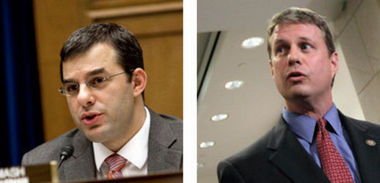
West Michigan Reps. Justin Amash and Bill Huizenga joined a majority
of Republican colleagues in agreeing to authorize a lawsuit against
President Barack Obama.
The measure, which passed the U.S. House by a 225-201 vote, gives Speaker John Boehner the authority to sue the president. They argue Obama's executive orders toward the Affordable Care Act, or "Obamacare," and other policy matters are unconstitutional.
Article here (via mlive).
 This is an update to this post, on whether the Congress can sue the President. It's an area of Constitutional law that hasn't been addressed before in the nation's history.
The measure, which passed the U.S. House by a 225-201 vote, gives Speaker John Boehner the authority to sue the president. They argue Obama's executive orders toward the Affordable Care Act, or "Obamacare," and other policy matters are unconstitutional.
Article here (via mlive).
Wednesday, July 2, 2014
Constitutional Law History: Can Congress sue the President?
The answer: we might be about to find out.
Article here.
 The problem is (or will be) whether the House has standing. What is standing? It means that the plaintiff has to have suffered something - a wrong - at the hands of the defendant. It's one of the basic steps of a lawsuit. In Constitutional Law terms, the plaintiff (or a group that is taking the plaintiff's shoes, like when an environmental group sues on behalf of its members) has to have suffered a wrong, the wrong must be "ripe" (called "mootness," or still needing to get a remedy from the court), and the court must be able to address the wrong (because the courts don't like to give advisory opinions, they prefer to settle something between actual parties).
Con Law was one of my favorite subjects, and this fact pattern seems like something out of an exam question, maybe for 5-10 points on a final exam.
Article here.
The good news for the House GOP is that courts have never said a congressional chamber may not sue the president for usurping legislative powers.
The bad news is they’ve never agreed to hear to such a case either. And scholars interviewed say they’re skeptical a court will make such a move anytime soon. Mr. Obama himself has brushed off the legal threat: “They’re not doing anything, and then they’re mad at me for doing something,” he said last week.

Con Law was one of my favorite subjects, and this fact pattern seems like something out of an exam question, maybe for 5-10 points on a final exam.
Wednesday, October 30, 2013
ACLU tells local municipalities to repeal anti-begging laws

Article here.
An Oct. 29 letter sent to the Ada Township attorney said: “We have reviewed your city ordinance and understand it to read as follows: No person shall: … Beg in any public place. …
“Ada Township’s ordinance, like the state law struck down in (the Grand Rapids case), prohibits begging in public places and is therefore unconstitutional on its face. We therefore advise you to repeal the ordinance and to instruct your local law enforcement agency to stop enforcing it immediately.”
Friday, October 18, 2013
Judge who delayed ruling on same-sex marriages "in middle of the road."
The judge who delayed ruling on same-sex marriages in Michigan earlier this week is said to be in the "middle of the road."
article here.
Attorneys for either side are using public policy arguments to help their cases. The Attorney for the state's side says, it's best for the people of a state to decide the issue, and they already have. The attorney for the plaintiffs says it's best for children to have married parents, and uses as influential law the United States v. Windsor decision, which legalized same-sex marriage earlier this year in the US Supreme Court.
Thursday, October 17, 2013
Michigan Attorney General to County clerks: Don't issue same-gender marriage licenses

In the mean time, the Michigan Attorney general Bill Schuette warned county clerks not to issue marriage licenses to same-gender couples, article here.
Tuesday, October 15, 2013
Affirmative action case before US Supreme Court today

Oral argument begins at 1pm, click this link to get to live feed of oral argument.
Subscribe to:
Posts (Atom)