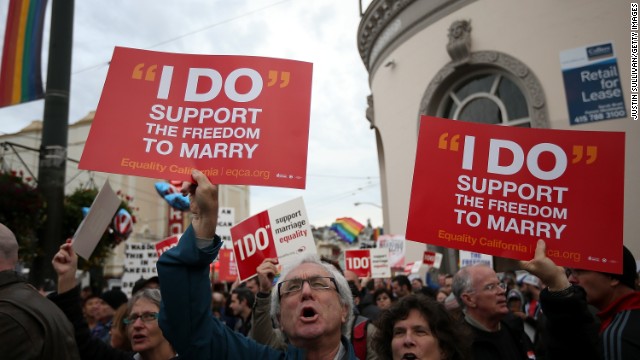
The Ottawa County clerk will manually update marriage forms to
accommodate same-sex couples in the event the U.S. Supreme Court
overturns Michigan's gay marriage ban.
It's not clear if Kent County's clerk, or some others around the state, will take the same step.
Article here (via mlive).
The Supreme Court is expected by the end of the month to rule on
whether Michigan's 2004 voter-approved gay marriage ban is
constitutional.
County clerks say they will comply with the court and issue marriage
licenses to same-sex couples if the court overturns Michigan's law. But
they may not have updated paperwork right away.
Showing posts with label same sex unions. Show all posts
Tuesday, June 23, 2015
Sunday, May 3, 2015
Same gender couples: Who gets your stuff? (an estate planning Q & A Primer)
The
issue: Michigan law currently does not recognize same gender couples.
This is true regardless of how the relationship was formed, or whether
the relationship was formed in Michigan or another state.
This means that decisions about to whom property
should pass, or the person who can make health care decisions will
become the "default" person under Michigan law. In other words, instead
of letting a partner in a same gender couple make decisions, that power
will then fall to next of kin.
I am in a long-term same-sex relationship, what will happen to my property or assets when I die?
A: That depends. If you have a validly executed will, you can name the person to whom property will pass, otherwise, Michigan law appoints how it will pass through its laws of intestacy. This will be your blood relations, and will ignore any same-gender relationship, regardless of the length of the relationship, any verbally stated intentions, or whether that relationship is legally recognized in another state.
Q: My parents have
always had a hard time recognizing that I have decided to live this way.
What should I do to show that I want my partner to inherit I am gone?
A: You should get your intentions written into a estate planning documents (a will, trust, or other document).
At a bare minimum, a will needs to appoint an executor (also known as
personal representative), and determine to whom property will pass at
your death. A will can also make it so that other people in your family
won't inherit property, if that is what you choose.
Q: I think it would be better if my personal matters remain private. Is there a way I can achieve this?
A: Yes. You can create a trust. A trust can operate
to distribute your property while you are alive, or after you die. The
advantage of a trust (over a will) is that it will not be part of public
record -- wills are "probated" which will then become public record.
Trusts are not.
Q: I am concerned
about whether my partner will be listened to if I am hospitalized. Can
my family - who have never been comfortable with our relationship -
exclude him from seeing me?
A: The family will have to recognize your wishes if you write them into a health care power of attorney (also called Patient Advocate designation). This document will outline how you wish to have your body treated, who can make that decision for you if you become incompetent, and any other health care decisions. Without this document, that duty will fall to immediate family members.
Q: Can my partner make financial decisions if I become incapacitated?
A: Yes, but only if a financial power of attorney (POA) is executed. You can write a POA to either become valid when you become incapacitated (also called "Springing") or for it to become effective on executiion (called "immediate.") Without a financial POA, again, Michigan will allow blood relations to make those decisions instead, in spite of any perviously stated intentions.
Q: What is your recommendation?
I think it's essential for same-gender couples to talk with an estate planning attorney to determine what documents are needed. At a minimum, a will, financial POA, and health care POA should be written to show what each person had planned.
Monday, January 19, 2015
Judge orders Michigan to recognize hundreds of same-gender marriages
A judge has ordered the state of Michigan to recognize about 300 same-sex marriages performed during a brief period last year when such unions were legal.
U.S. District Judge Mark A. Goldsmith, ruling in favor of eight same-sex couples Thursday, said those marriages are valid, the Associated Press, the Wall Street Journal (sub. req.) and others report.
The marriages were performed in four counties during a brief period last March after a different federal court judge struck down the state’s gay marriage ban. The Cincinnati-based 6th U.S. Circuit Court of Appeals later suspended the decision and reinstated the ban.
The judge, however, stayed his ruling for 21 days to give the state an opportunity to appeal.
Article here (via aba journal).
U.S. District Judge Mark A. Goldsmith, ruling in favor of eight same-sex couples Thursday, said those marriages are valid, the Associated Press, the Wall Street Journal (sub. req.) and others report.
The marriages were performed in four counties during a brief period last March after a different federal court judge struck down the state’s gay marriage ban. The Cincinnati-based 6th U.S. Circuit Court of Appeals later suspended the decision and reinstated the ban.
The judge, however, stayed his ruling for 21 days to give the state an opportunity to appeal.
Article here (via aba journal).
Wednesday, March 26, 2014
Federal Apeals Court extends stay on same gender marriages
The nearly 300 same-sex Michigan couples who got married last weekend
will face a longer wait to learn whether their vows will be legally
valid.
Article here.
The 6th Circuit Court of Appeals on Tuesday extended a stay on last week’s ruling by U.S. District Court Judge Bernard Friedman that struck down the Michigan’s ban on same-sex marriage.
The 2-1 ruling, issued late Tuesday afternoon, means the case will have to make its way through the appellate court, and likely the U.S. Supreme Court, before the couples know whether their marriages will be legally recognized.
Article here.
The 6th Circuit Court of Appeals on Tuesday extended a stay on last week’s ruling by U.S. District Court Judge Bernard Friedman that struck down the Michigan’s ban on same-sex marriage.
The 2-1 ruling, issued late Tuesday afternoon, means the case will have to make its way through the appellate court, and likely the U.S. Supreme Court, before the couples know whether their marriages will be legally recognized.
Tuesday, February 25, 2014
Civil rights and same-gender marriages, will Michigan allow this? Trial starts today.
Michigan’s highly anticipated gay marriage trial gets underway today in
Detroit, where a federal judge will hear the pros and cons of children
being raised in same-sex families and ultimately decide what the
definition of marriage should be and will be in this state.
Michigan has a voter-approved ban on same-gender marriages, that essentially defines marriage in Michigan as between one man and one woman. This was about 10 years ago.
Article here.
Michigan’s case involves two Hazel Park nurses who are challenging the state's ban on same-sex marriage and same-sex adoption, arguing the bans unlawfully violate their right to get married and adopt each other's children. The plaintiffs, April DeBoer and Jayne Rowse, filed their suit in January 2012, initially raising only the adoption issue, but then challenging the gay marriage prohibition as well.
My personal take on this: I wrote an article (unpublished, email me for a copy) about equal protection for persons with disabilities. Even if the federal Court in today's trial decides to drop the voter-approved ban on same-gender marriages (which the Supreme Court views in the same category as persons with disabilities), what will happen at the next level? The Supremes have been on this issue for a bit in other cases, but haven't changed the level of constitutional scrutiny for this group.
Michigan has a voter-approved ban on same-gender marriages, that essentially defines marriage in Michigan as between one man and one woman. This was about 10 years ago.
Article here.
Michigan’s case involves two Hazel Park nurses who are challenging the state's ban on same-sex marriage and same-sex adoption, arguing the bans unlawfully violate their right to get married and adopt each other's children. The plaintiffs, April DeBoer and Jayne Rowse, filed their suit in January 2012, initially raising only the adoption issue, but then challenging the gay marriage prohibition as well.
My personal take on this: I wrote an article (unpublished, email me for a copy) about equal protection for persons with disabilities. Even if the federal Court in today's trial decides to drop the voter-approved ban on same-gender marriages (which the Supreme Court views in the same category as persons with disabilities), what will happen at the next level? The Supremes have been on this issue for a bit in other cases, but haven't changed the level of constitutional scrutiny for this group.
Monday, January 6, 2014
Does allowing a name-change on a driver's license amount to "recognition" of same-gender marriage?
From the Detroit News:
A provision of the Michigan Constitution that voters approved in 2004 bans same-sex marriages, so Jesse Sherman and Derek Melot went to New York to get married in October.
Article here.
A provision of the Michigan Constitution that voters approved in 2004 bans same-sex marriages, so Jesse Sherman and Derek Melot went to New York to get married in October.
But later, when Jesse Melot went to two
Michigan Secretary of State offices with his marriage certificate,
seeking to have his new name put on his driver’s license, clerks in both
offices declined to do so.
Although
he could spend money to have his name changed legally, married people
normally can do that just by showing a marriage certificate.
Article here.
Tuesday, October 29, 2013
No custody rights, says Michigan Court of Appeals to parent in same-gender couple
article here.
The Michigan Court of Appeals has agreed with a Dickinson County judge who dismissed a lawsuit by Jennifer Stankevich who was seeking custody and other rights from her former partner, Leanne Milliron.
Stankevich and Milliron had entered into a same-sex marriage in Canada in 2007 but separated two years later.
While Stankevich apparently had a role in the child’s early life, the court ruled Milliron is the biological mother, and since Michigan doesn’t recognize same-sex marriage, she thereby has the upper hand in any legal action.
Side Note: I think that this may be an inequitable result, but probably will be upheld if it goes to a higher court. If there's a heterosexual couple, where children are residing with a biological parent, and one person is not the biological parent, and doesn't make an effort to adopt children who he/she is parenting, then they have no standing for custody when the adult relationship ends. This is similar to how the court here viewed the standing of the non-biological mom in this same-gender couple.
Friday, October 18, 2013
Judge who delayed ruling on same-sex marriages "in middle of the road."
The judge who delayed ruling on same-sex marriages in Michigan earlier this week is said to be in the "middle of the road."
article here.
Attorneys for either side are using public policy arguments to help their cases. The Attorney for the state's side says, it's best for the people of a state to decide the issue, and they already have. The attorney for the plaintiffs says it's best for children to have married parents, and uses as influential law the United States v. Windsor decision, which legalized same-sex marriage earlier this year in the US Supreme Court.
article here.
Attorneys for either side are using public policy arguments to help their cases. The Attorney for the state's side says, it's best for the people of a state to decide the issue, and they already have. The attorney for the plaintiffs says it's best for children to have married parents, and uses as influential law the United States v. Windsor decision, which legalized same-sex marriage earlier this year in the US Supreme Court.
Thursday, October 17, 2013
Michigan Attorney General to County clerks: Don't issue same-gender marriage licenses
Update: a Federal district court judge was expected to issue a ruling at a hearing October 16 about whether Michigan's same-sex voter ban was constitutional. He delayed giving a ruling, opting instead for scheduling an expedited trial. Article here.
In the mean time, the Michigan Attorney general Bill Schuette warned county clerks not to issue marriage licenses to same-gender couples, article here.
Wednesday, October 16, 2013
Same gender marriage: today in Michigan?
Clerks in at least 10 of Michigan's 83 counties are prepared to issue
marriage licenses this week if US District Court Judge Bernard Friedman strikes down the state's
voter-approved ban, according to this MLive report.
Clerks in Bay, Clare, Delta, Ingham, Isabella, Lapeer, Midland,
Oakland, Tuscola and Washtenaw counties indicated that they are ready to
begin issuing licenses immediately after a ruling.
Full article here.
So that means that if a federal judge this week strikes down a voter-approved ban on same-sex marriage in Michigan, same-gender marriages could be legal in Michigan, at least until a higher court says otherwise, which could be only a matter of hours or days.
Full article here.
So that means that if a federal judge this week strikes down a voter-approved ban on same-sex marriage in Michigan, same-gender marriages could be legal in Michigan, at least until a higher court says otherwise, which could be only a matter of hours or days.
Tuesday, October 8, 2013
What's the tax ramification for a same-gender couple?
In August of this year, the IRS issued a ruling (Notice 2013-61) that rules that same- gender couples
legally married in jurisdictions that recognize their marriages, will be treated as married for federal tax purposes. The ruling applies regardless of whether the couple lives in a jurisdiction that recognizes same-sex marriage or a jurisdiction that does not recognize same-sex marriage.
:For More information: IRS.gov
legally married in jurisdictions that recognize their marriages, will be treated as married for federal tax purposes. The ruling applies regardless of whether the couple lives in a jurisdiction that recognizes same-sex marriage or a jurisdiction that does not recognize same-sex marriage.
:For More information: IRS.gov
Subscribe to:
Posts (Atom)